

Real Estate AI Lead Qualification: Capture Intent, Timing, Property Needs & Next-Step Readiness
Peak Demand builds custom Voice AI workflows that can speak with buyers, sellers, renters, and investors, understand what they need, capture the context your team actually uses, and move each conversation toward the appropriate next step.
Buyer, seller, renter, investor, listing inquiry, showing request, valuation, or exploratory call.
Property type, location, timing, must-haves, budget context, and approved qualification details.
Route, book, notify, write to CRM, trigger follow-up, or hold for human review.
A real estate lead is more than a name and phone number.
Lead capture tells you who contacted the brokerage. Lead qualification helps your team understand why they called, what they need, when they are likely to act, and what should happen next.
Peak Demand designs custom Real Estate AI workflows so buyer, seller, renter, and investor conversations can become structured operational context instead of an unorganized voicemail, missed call, or generic contact form submission.
The Voice AI layer can ask approved questions, adapt to the caller's answers, capture transaction-relevant information, and move the conversation into a configured workflow such as a showing request, listing consultation, agent callback, CRM update, nurture path, or human review.
- Designed for real estate teams that need more than basic lead capture or call forwarding.
- Built around buyer, seller, renter, investor, property inquiry, showing, consultation, and follow-up workflows.
- Structured so qualification data can move into the systems, routing logic, and next-step process your team already uses.

The goal is to understand the inquiry well enough to create the right next step, with human judgment retained where the brokerage wants it.
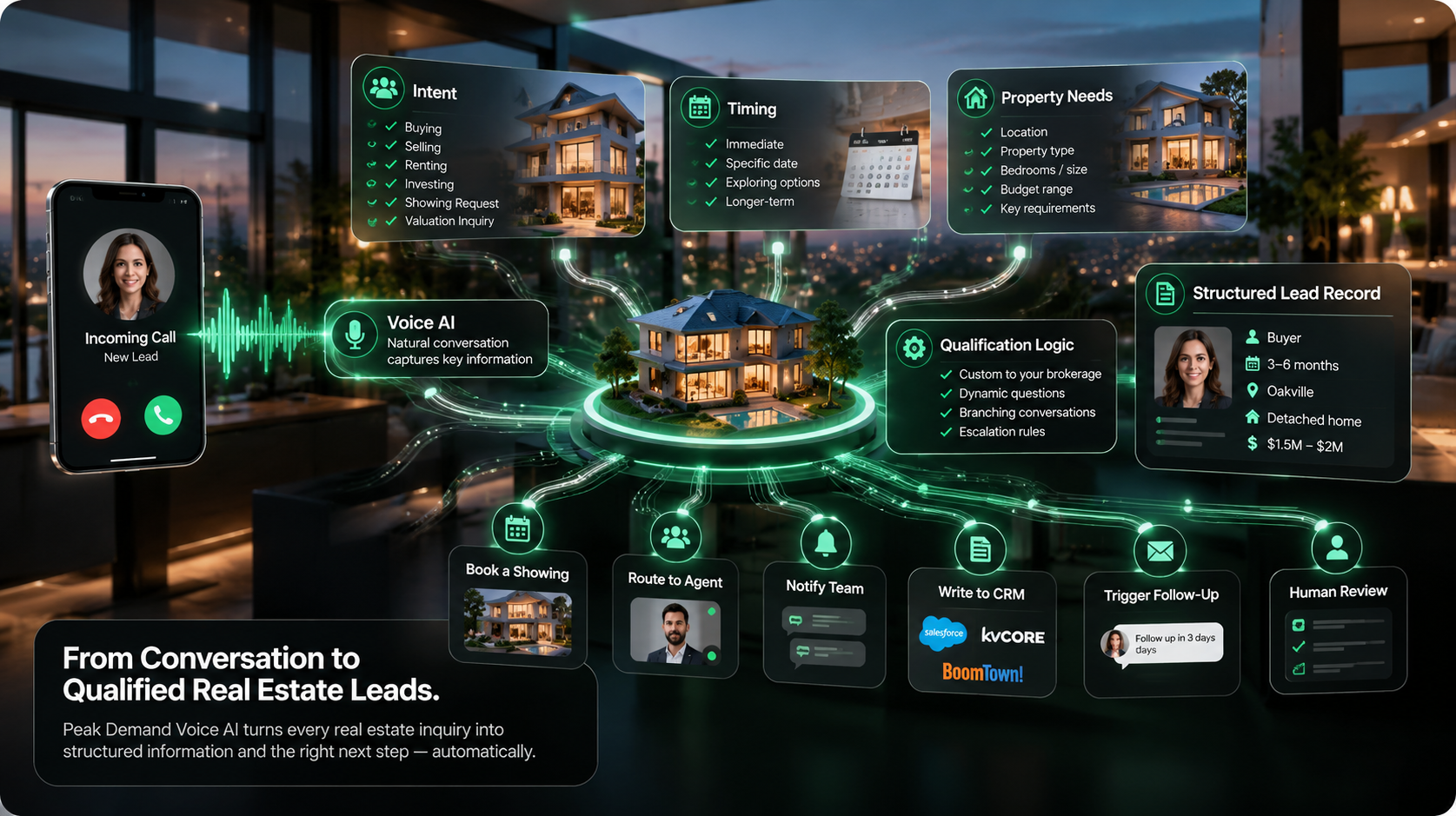
Every qualified conversation should clarify intent, timing, property needs, and next-step readiness.
Those four signals give the team enough context to understand what kind of opportunity or service request is in front of them without forcing every caller through the same rigid questionnaire.
Intent
Identify whether the caller is buying, selling, renting, investing, requesting a showing, asking about a listing, seeking a valuation, or exploring options.
Timing
Capture whether the need is immediate, tied to a specific upcoming date, exploratory, or part of a longer-term plan.
Property needs
Collect approved details such as location, property type, bedrooms, commercial or residential use, price or budget context, and important requirements.
Next-step readiness
Understand whether the caller is ready for a showing, listing consultation, agent callback, additional information, follow-up, or another approved path.
Peak Demand can design the conversation so questions appear when relevant, unnecessary questions are skipped, and the caller can explain what they need in natural language.
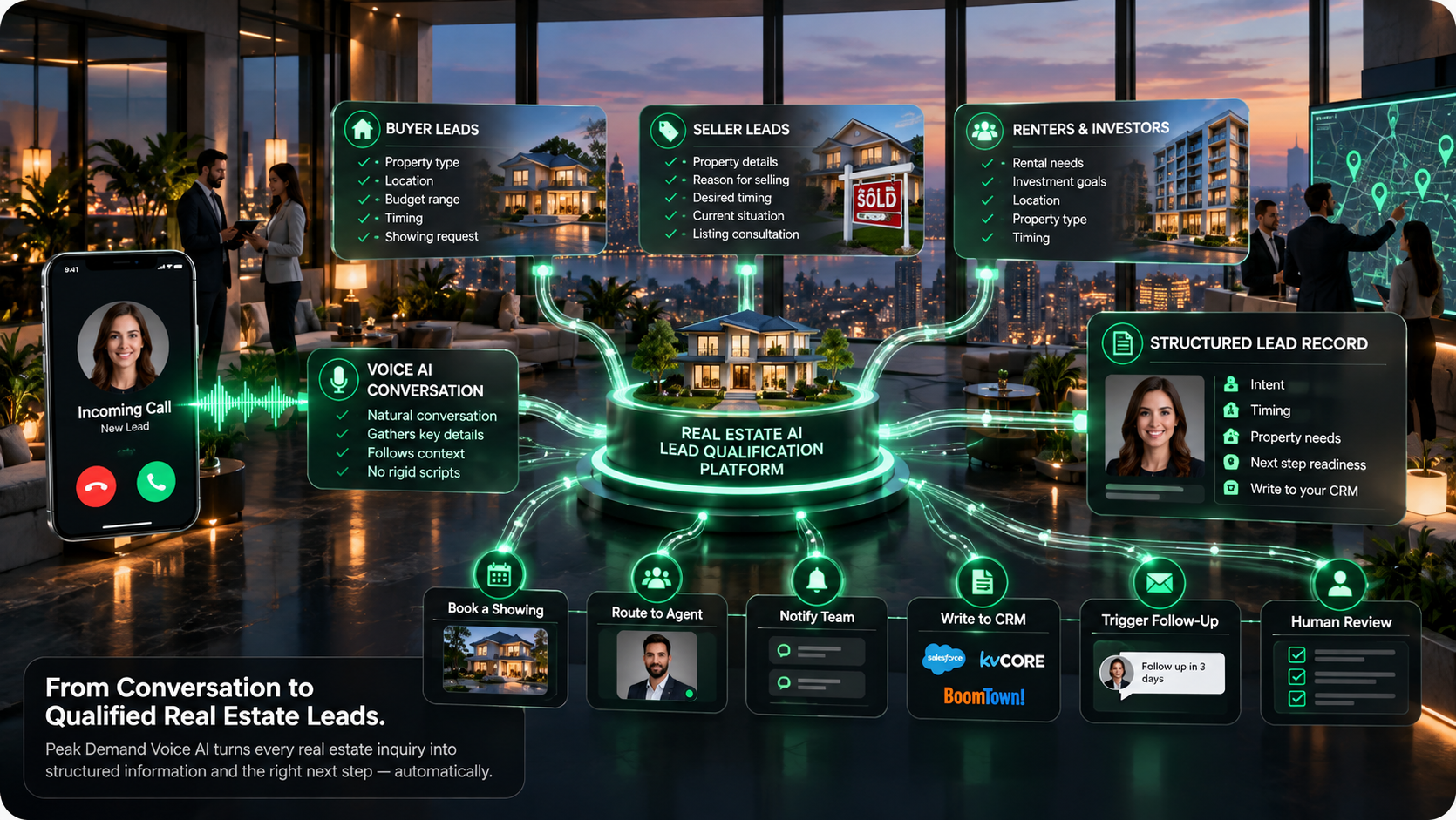
Buyer and seller leads should not follow the same script.
A buyer calling about a property and a homeowner considering a listing need different questions, different context, and often a different next step. The Voice AI workflow should branch accordingly.
Buyer qualification path
Identify the property or location of interest, capture needs and must-haves, understand timing, collect approved readiness information, and move toward a showing, consultation, or agent follow-up.
Seller qualification path
Capture property details, reason for inquiry, desired timing, current situation, and whether the homeowner is ready for a listing consultation, valuation discussion, callback, or follow-up.
Your brokerage should define the qualification logic.
Peak Demand does not force every real estate team into the same prebuilt lead-scoring script. The workflow can be designed around your markets, team structure, property types, service model, routing rules, and approved next steps.
Custom questions
Define the information your team actually needs for buyers, sellers, renters, investors, listing inquiries, showing requests, and other supported call types.
Branching conversations
Ask different questions depending on the caller's answers instead of walking everyone through the same static intake sequence.
Market and territory logic
Use location, property type, service area, language, team ownership, or other approved criteria to determine the appropriate path.
Agent and team assignment
Route qualified conversations to the right agent, team, office, specialty, or callback queue according to your operating model.
Escalation rules
Recognize exceptions, urgent matters, sensitive issues, unclear requests, or situations where the AI should stop and move to a human-approved path.
Human review points
Keep brokerage staff in control where approval, judgment, interpretation, negotiation, or manual follow-up is required before action is taken.
Questions, branches, routing rules, territories, property categories, handoffs, system actions, and human-review points can be designed around the brokerage instead of around a generic AI product template.
The conversation should become a record your team can use.
A qualified call becomes more valuable when the important details are organized into fields, summaries, ownership rules, and next actions instead of remaining buried inside a transcript or voicemail.
When the caller is ready, the workflow should know what happens next.
Qualification is useful when it connects the conversation to an operational action. The appropriate next step depends on your systems, permissions, business rules, team availability, and what the caller is trying to accomplish.
Book or request a showing
Move a property-specific buyer inquiry into a showing request or scheduling workflow where the connected system and business rules allow it.
Route to the right agent
Use approved ownership, geography, office, specialty, language, property type, or team rules to determine who should receive the lead.
Write structured information to CRM
Create or update a lead record, add a summary, tag intent, assign ownership, and trigger approved tasks where integration access supports it.
Notify the team
Send structured alerts or summaries when the team needs to know about a showing request, listing opportunity, urgent callback, or other configured event.
Trigger approved follow-up
Create a callback task, follow-up sequence, reminder, or nurture event based on the caller's stated timeline and the brokerage's approved process.
Hold for human review
Keep a human reviewer in the loop for exceptions, sensitive matters, ambiguous qualification, professional judgment, or actions that should not be automated.
Qualification should feel like a real conversation.
Real estate callers rarely explain their needs in a perfect order. A useful Voice AI workflow should follow context, ask relevant follow-up questions, avoid unnecessary repetition, and move naturally toward the next step.
- Ask only the questions relevant to the caller's stated goal and the brokerage's approved workflow.
- Use prior answers from the same conversation so callers are not repeatedly asked for information they already provided.
- Allow callers to correct details, change direction, ask a property question, or explain a more complex situation.
- Recognize when the caller wants to speak with an agent or brokerage team member and move to the configured human handoff or callback path.
- Use clear disclosure and transparent language where the brokerage's policy or local requirements call for it.
Qualification should connect to the systems your real estate team already uses.
The value of qualification increases when the captured context can move into the CRM, calendar, showing process, agent-routing workflow, messaging tools, reporting layer, or another approved system.
Peak Demand can design integration paths around the systems, APIs, permissions, data fields, ownership rules, and workflow constraints involved. Some actions can be completed directly when supported, while others should create structured handoffs, alerts, review tasks, or approval-based workflows.
For broader system-by-system integration information, explore Peak Demand's Voice AI API integration services.
CRM and pipeline updates
Create or update contacts, attach conversation summaries, tag lead intent, assign owners, move approved stages, and create follow-up tasks.
Showing and consultation scheduling
Connect qualified conversations to showing requests, consultations, calendars, callback windows, or structured scheduling handoffs.
Routing, alerts, and middleware
Use middleware or workflow logic to connect calls to the right office, agent, inbox, notification path, reporting event, or human review process.
Your team should be able to see what the AI is learning and what happens next.
Lead qualification should not become a black box. Reporting and review can help teams understand the kinds of inquiries arriving, the information being captured, the actions being created, and where workflows need refinement.
Peak Demand can support call review, workflow tuning, integration checks, reporting updates, and qualification refinements after launch so the system stays aligned with the brokerage.
Use AI to organize the conversation, not replace professional judgment.
Real Estate AI lead qualification should focus on transaction-relevant context and approved operational workflows. It should not infer, rank, or treat callers or leads differently based on protected personal characteristics.
Peak Demand can design clear rules for what the AI is allowed to collect, what it can update, when it should escalate, which actions require human review, and how data moves into connected systems. Brokerages should define their own lawful operating rules and obtain appropriate legal or compliance guidance where needed.
Transaction-relevant data
Focus the qualification workflow on property, timing, service need, contact, scheduling, ownership, and other information that supports the real estate process.
Approved actions only
Define what the AI can complete, what it can suggest, what it should only summarize, and what requires human approval before action.
Human handoff and review
Keep clear escalation paths for sensitive conversations, ambiguity, exceptions, negotiation, professional advice, or any decision that should stay with a licensed real estate professional or authorized brokerage staff member.
The Voice AI layer can organize information and create the next action while agents retain the relationship, judgment, negotiation, and professional responsibilities that belong with them.
Questions real estate teams ask about AI lead qualification.
These answers are written for brokerages, real estate teams, multi-office groups, property professionals, operations leaders, and marketing teams evaluating custom Voice AI qualification workflows.
What is Real Estate AI lead qualification?
How is AI lead qualification different from basic real estate lead capture?
How does AI qualify real estate leads?
What information can a Real Estate AI agent collect?
Can AI qualify both buyer and seller leads?
Can the qualification questions be customized for our brokerage?
Can the AI identify whether a caller is ready to book a showing?
Can AI lead qualification work after hours?
Can qualification data be written into our CRM?
What happens when a high-intent real estate lead is identified?
Does the AI automatically reject unqualified leads?
Can the AI hand a caller to a real estate agent?
How is AI lead qualification different from a website lead form?
Can the AI qualify renters and real estate investors too?
How do you handle fair housing and protected characteristics?
What happens when the AI should not continue the conversation?
Can Peak Demand manage the qualification workflow after launch?
What should we bring to a Real Estate AI discovery call?
Need every property inquiry turned into clearer context and the right next step?
Peak Demand designs custom Real Estate AI lead qualification workflows for buyer and seller intent, timing, property needs, next-step readiness, CRM updates, routing, booking, human handoff, reporting, QA, and ongoing optimization.
This is strongest when the brokerage needs the conversation to produce structured context, ownership, routing, follow-up, system updates, and a clear next action.
Peak Demand can manage the qualification layer as an ongoing workflow, not a static script that is left untouched after launch.